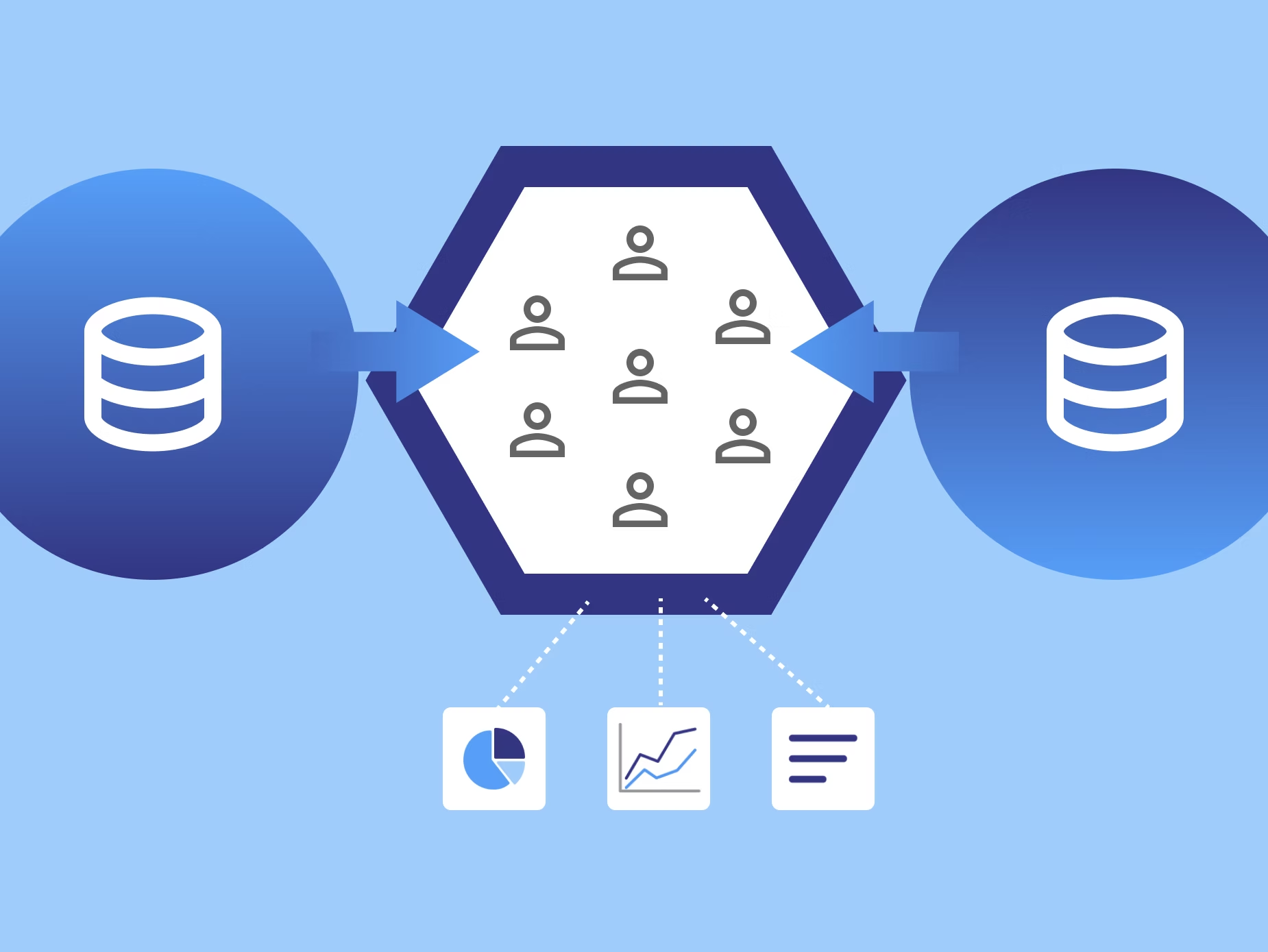
In an era where data drives everything—from lending decisions to fraud detection—organizations across finance, healthcare, and telecom face a growing paradox:
The answer lies in privacy-preserving machine learning—a new paradigm that enables powerful insights while keeping raw data private.
Why Privacy Matters More Than Ever
Organizations today sit on vast amounts of personal data:
Banks have customer financial histories
Insurers store health and claim records
Telcos collect user mobility and device patterns
This data is gold for AI, but also a liability if leaked, misused, or breached. Regulatory mandates like RBI’s privacy framework, DPDP (India), GDPR (EU), and rising public scrutiny demand one thing:
The Traditional ML Workflow Is Broken
Traditional ML requires aggregating data in centralized servers or data lakes. This exposes sensitive information to:
Internal misuse
Cross-party leakage
Attacks during training or inference
But what if we could train and infer on encrypted or protected data—without ever revealing it?
Enter: Privacy-Preserving Machine Learning (PPML)
PPML is a set of technologies that allow machine learning on private data without compromising its confidentiality.

Some of the core techniques include:
Homomorphic Encryption (HE)
Encrypts data such that computation can be performed directly on ciphertext, and only results can be decrypted.
Secure Multi-Party Computation (SMPC)
Enables multiple entities to jointly compute a function over their inputs while keeping them private.
Federated Learning
Trains models locally on user devices or servers, sending only model updates—not raw data.
Real Use Cases in Finance
Let’s explore how banks and lenders can put PPML to work today:
1. Loan Default Prediction Without Seeing User Data
Lenders can:
Encrypt a borrower’s financial attributes
Run a prediction model on the encrypted data
Get encrypted risk scores
Decrypt only the final result
This ensures model inference happens privately, even on sensitive financial data.
2. Collaborative Fraud Detection Across Banks
Using SMPC or federated models, banks can:
Share risk indicators of suspicious accounts
Build shared fraud scores
Without revealing PII or internal rules
3. Personalized Wealth Recommendations
Wealth advisors can:
Analyze spending, deposits, and investments
Deliver recommendations
Without accessing raw transaction data
How It Works: A Sample Architecture
Here's how a lender can use Homomorphic Encryption for private ML inference:
Borrower's financial data (from internal systems or Account Aggregator)
Data is encrypted locally using HE
Encrypted data is sent to a model server (e.g., PryvX)
Inference is done on encrypted inputs
Encrypted result is returned
Lender decrypts and gets the risk score
The model never sees raw user data.
Secure, compliant, and private.
Getting Started: Demo App

We built a demo app that predicts loan default:
Takes user input (like age, income, credit score)
Encrypts it using Homomorphic Encryption
Performs logistic regression on encrypted values
Shows a decrypted default probability
The Business Case
Adopting PPML isn’t just a technical decision—it’s a strategic moat.
Comply with privacy regulations
Build trust with users
Enable smarter decisions with broader collaboration
Avoid risks of central data exposure
In the coming years, AI and privacy will no longer be separate tracks. They’ll be intertwined.
Ready to Collaborate?
At PryvX, we help organizations build privacy-preserving AI pipelines using techniques like HE, SMPC, and federated learning. We work with:
Banks
Fintechs
Telcos
Let’s unlock value from sensitive data—without ever compromising it.
Reach out for a demo or pilot.