Telecom Companies Are Sitting on a Data Goldmine But Can’t Use It Fully
Telecom operators generate massive amounts of data every day from network usage, mobility patterns, device behavior, payment top-ups, and fraud signals. This data is extremely valuable for banks, insurers, governments, and enterprises.
But there is a problem:
- Regulations restrict sharing personal data
- Customers are sensitive about privacy
- Raw data sharing is risky and often illegal
So most telecom data stays unused or only used internally.
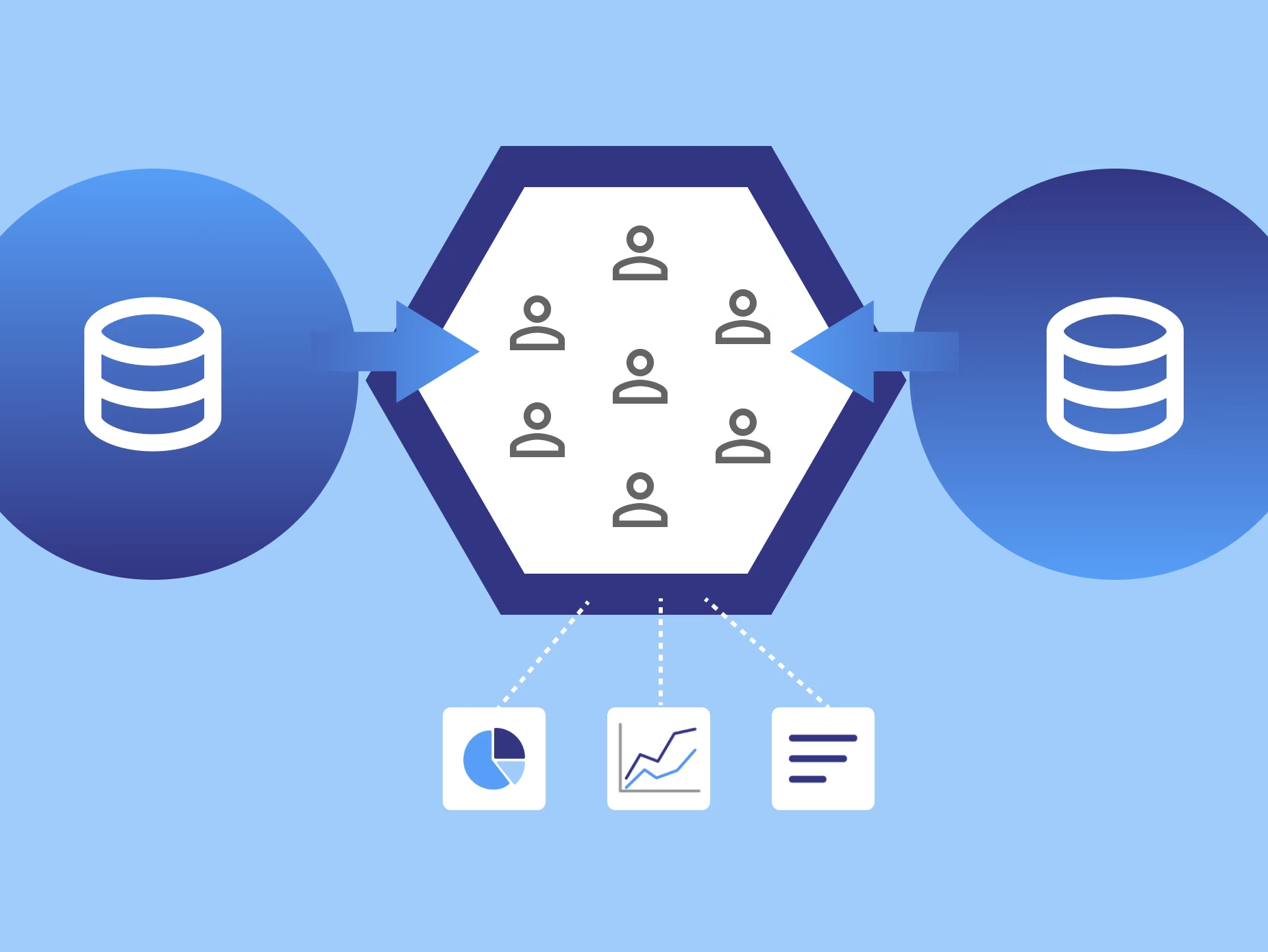
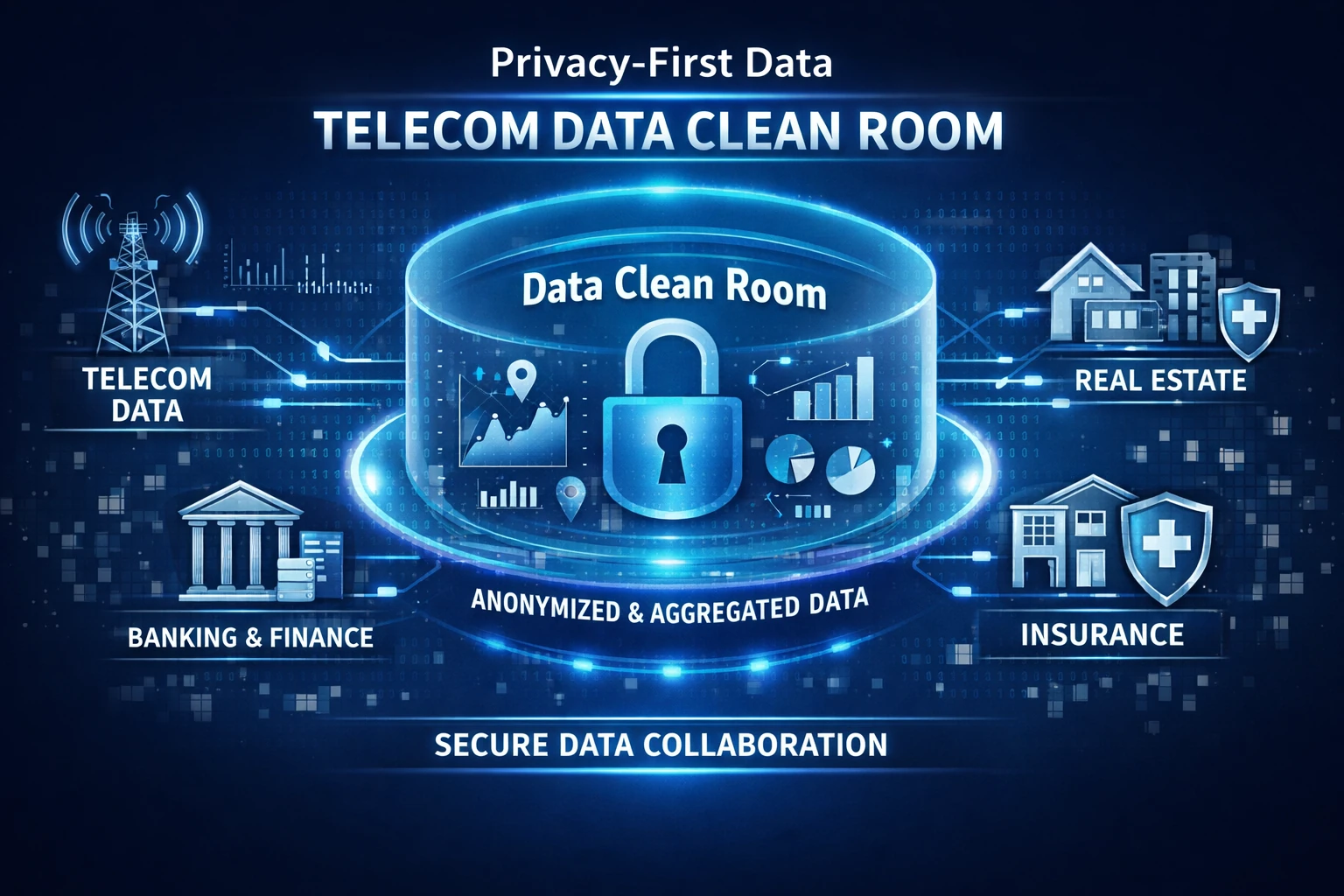
Data Clean Rooms (DCRs) change this. They allow telecom companies to collaborate with partners using aggregated and anonymized data without exposing individual users.
What Is a Telecom Data Clean Room (In Simple Terms)?
A data clean room is a secure environment where two or more organizations can analyze data together without sharing raw data or personal identifiers.
For telecoms, this means:
- Banks can query telecom signals without revealing phone numbers
- Cities can analyze mobility without tracking individuals
- Real estate firms can study footfall without spying on people
The output is aggregated insights, scores, and statistics not personal records.
Why Aggregated Telecom Data Is Extremely Valuable
Telecom data is unique because it reflects real-world behavior at population scale. Examples of aggregated insights:
- Mobility heatmaps by area
- Device and network quality statistics
- Fraud activity patterns by region
- Economic activity proxies (top-ups, data usage)
- Population density and movement trends
These insights are powerful for many industries even without knowing who the user is.
High-Impact Cross-Industry Use Cases for Telecom Clean Rooms
1) Financial Services & Banking: Fraud and Credit Intelligence
Banks struggle with fraud like SIM swap, account takeover, and mule accounts. Telecom networks detect these signals first.
What banks can query in a clean room:
- Recent SIM change frequency
- Device stability scores
- Location stability metrics
- Network behavior anomalies
Practical output:
- Fraud risk score API for banks
- Creditworthiness signals for thin-file customers
- Early warning system for identity fraud
This is highly monetizable banks will pay per API call or per score.
2) Real Estate & Retail: Footfall and Location Intelligence
Real estate developers and retailers want to know:
- Which areas are growing?
- How many people visit a location?
- What is the demographic movement trend?
Telecom clean room can provide:
- Aggregated footfall by zone
- Day vs night population shifts
- Commuter vs resident density
- Seasonal movement trends
Practical business model:
- Sell analytics dashboards to developers, malls, and retail chains
- Provide location intelligence reports for site selection
3) Smart Cities & Government Planning
Governments need mobility data for:
- Traffic planning
- Public transport optimization
- Disaster response
- Urban zoning
Clean room outputs:
- City-level mobility flows
- Congestion heatmaps
- Crowd density during events
- Population movement during emergencies
No individual tracking only statistical patterns.
Telecoms can offer Data-as-a-Service to municipalities.
4) Insurance & Risk Modeling
Insurers need behavioral data to price risk. Telecom data provides proxies for:
- Lifestyle stability
- Travel frequency
- Economic activity
Clean room insights:
- Regional risk clusters
- Mobility volatility indices
- Behavioral stability metrics
Revenue model:
- Risk intelligence subscription for insurers
5) Advertising & Consumer Insights (Privacy-First)
With cookies dying, brands struggle to measure campaigns. Telecom aggregated data can help:
- Audience segmentation by geography
- Campaign reach estimation
- Offline-to-online conversion measurement
All done without revealing personal identities.
Telecoms can become privacy-first marketing data providers.
What Makes Telecom Clean Rooms Different From Regular Data Sharing
Traditional data sharing:
- Raw datasets copied
- High privacy risk
- Heavy legal approvals
Clean rooms:
- Data never leaves operator control
- Only aggregated outputs are shared
- Strong encryption and privacy tech (HE, SMPC, Confidential Computing)
This allows new partnerships that were previously impossible.
Why This Matters Strategically for Telecoms
Voice and SMS revenues are declining. Data connectivity is commoditized.
Aggregated data intelligence is one of the few high-margin new revenue streams telecoms can build.
Clean rooms allow telecoms to:
- Monetize data safely
- Stay compliant with regulations
- Build deep partnerships with banks, governments, and enterprises
- Position themselves as trusted data infrastructure providers
Key Takeaway
Telecom operators don’t need to sell personal data to create value. Aggregated, anonymized insights are enough to transform industries.
Data clean rooms make it possible to collaborate across banking, real estate, smart cities, insurance, and retail without compromising privacy.
For telecom companies, clean rooms are not just a technology upgrade they are a new business platform.